Distribution network    Contact    
  • DE
  • Tag: EN

    CERN, the European Organization for Nuclear Research, is one of the world’s most important and renowned centers for fundamental physics research. In its large-scale experimental facilities, scientists investigate the fundamental building blocks of matter and the underlying laws of nature.
    Some of the most complex technical systems ever built are used for this purpose.

    picture: olrat – stock.adobe.com

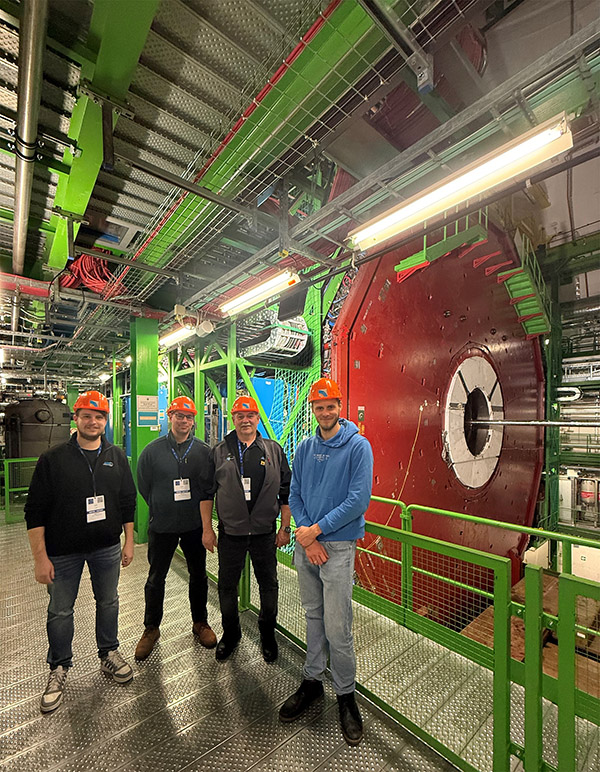
    As part of a joint project, SEHO is currently working with CERN on a prototype system for a key process step in the production of non-insulated coils made from high-temperature superconductors. These superconductors are considered as a key technology for high-performance, highly compact magnetic coils that will enable unprecedented magnetic field strengths in future particle accelerators, while also increasing efficiency.
    The project is part of the MuCol (Muon Collider) program coordinated by CERN and thus makes an important contribution to the development of the next generation of accelerator technologies.

    SEHO contributes its many years of experience in the precise handling of liquid solder and in the design of stable, reproducible process sequences. A particular focus is on the controlled and process-reliable application of flux – a decisive quality factor for reliable metallic joints and the functional integrity of the superconducting components.
    With this combination of process expertise and system engineering competence, SEHO supports CERN in taking the step from experimental development toward a robust, industrial-grade prototype solution

    The on-site exchange at CERN was not only to align technical details, but also to develop a shared understanding of the entire process chain – from material science requirements to system-level implementation.

    SEHO is excited and proud to be part of this international project and to contribute its technologies in an environment where cutting-edge research and industrial manufacturing expertise are closely linked.
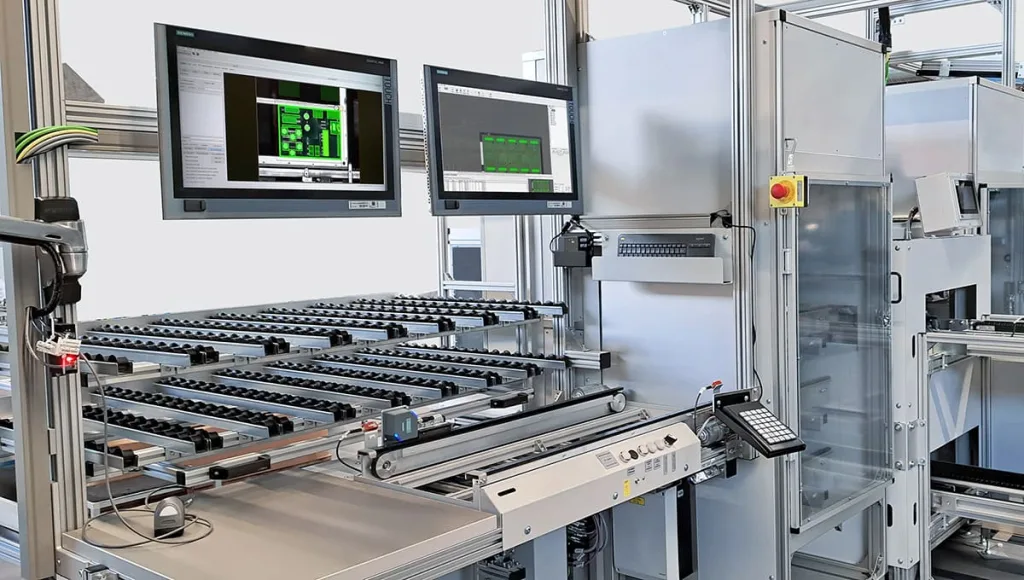
    SEHO is further expanding its existing cooperation with ANS answer elektronik GmbH. Following the successful sales partnership in Southern Germany, the collaboration is now being extended to markets in Austria and Switzerland. With this step, both companies are responding to the growing demand for integrated SMT and THT manufacturing solutions in the DACH region and strengthening their joint market presence.

    For many years, ANS has been one of the established full-range suppliers of SMD manufacturing equipment and has extensive experience in the planning and implementation of complete production lines.
    Sales responsibility for customers in Austria and Switzerland will now be taken over by Levent Akbulut from ANS. He is highly familiar with SEHO’s equipment, processes and market requirements, and has more than 27 years of experience in the electronics industry, including almost 19 years with SEHO Systems GmbH. His long-standing practical experience on both equipment and process level provides the foundation for providing competent and solution-oriented consulting regarding SEHO’s soldering processes and automation technology.

    “SEHO’s systems are an ideal addition to our product portfolio. By extending the partnership to Austria and Switzerland, we can now provide comprehensive support to electronics manufacturers in these countries with the implementation of modern, complex SMT and THT manufacturing concepts,” explains Sebastian Glitsch, Managing Director of ANS answer elektronik GmbH.

    SEHO also sees the expanded cooperation as an important step forward. “Previous joint projects have shown that our respective areas of expertise result in strong synergies for our customers. With ANS and Levent Akbulut’s many years of experience, our customers in Austria and Switzerland have access to a contact person with profound process know-how and high application competence,” says Rainer Dries, Sales Coordinator SEHO Systems GmbH.

    The shared objective is to support electronics manufacturers in both countries in implementing efficient, stable, and future-proof manufacturing processes and to provide them with complete line solutions from a single source.

    How Automated THT Manufacturing Pays Off and Boosts Competitiveness.

    Electronics manufacturing is under pressure: product customization and market dynamics demand maximum flexibility while maintaining consistent quality. In the THT sector in particular, it is apparent how much economic success depends on well-designed automation.

    No two cars are alike today, modern control technology is built to order, and industrial electronic components are individually tailored to customer requirements – to name just a few examples. At the same time, sales markets fluctuate noticeably, whether due to economic effects, geopolitical influences, or changing customer needs.
    The increasing individualization of products and unsteady market demand place high expectations on electronics manufacturing: it must not only be flexible enough to produce a wide variety of assemblies and variants economically but also must be able to efficiently manufacture large series and small, specialized quantities – all while maintaining consistently high quality.
    The challenge lies in striking a balance between flexibility, speed, and cost efficiency under increasingly complex conditions.

    The demands placed on modern electronics manufacturing often clash with reality, and in addition to technological requirements, the human factor is increasingly coming into focus.
    While automated processes are already established in other areas of electronics production, many process steps in THT manufacturing are still carried out manually. This is precisely where bottlenecks are increasingly occurring: skilled labor shortages, absences due to illness, rising wage costs, and higher error rates are putting pressure on production, especially when order volumes fluctuate. In addition, manual tasks affect cycle times and make complete traceability difficult, as processes cannot be recorded digitally throughout.

    Step-by-step automation: Tailored to individual needs and scalable

    One solution lies in the gradual, demand-oriented automation of THT manufacturing. Finding the right balance is key: complete automation is not always necessary, but targeted partial automation can already achieve noticeable effects – for example, in reducing errors, ensuring consistent quality, or maintaining a stable cycle time.
    A scalable approach is essential, whereby the degree of automation can be adapted to the current workload and the vertical range of manufacture.
    Equally important is a coherent concept for the interaction between operating personnel and the system. Ergonomic workplace design, simple operating concepts, and clear interfaces between humans and machines promote acceptance and increase efficiency.
    When considering the automation of a production area, the future viability of the system should also be taken into account. A flexible concept must be able to accommodate changes in the product life cycle: increasing quantities, additional variants, or a higher degree of automation should be achievable without fundamental modifications.

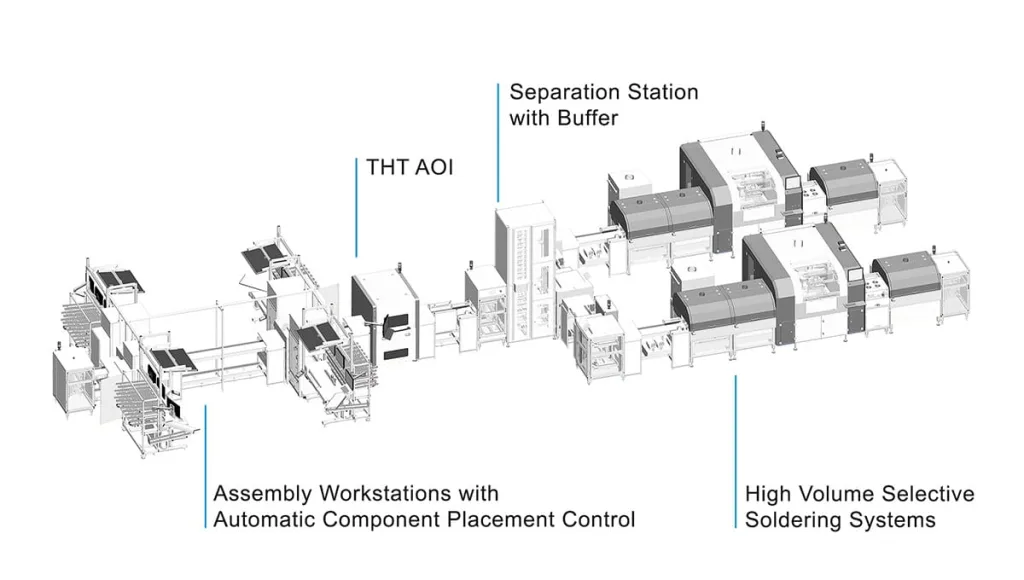
    ergonomic assembly workstation with component placement control
    scalable, automated production line

    Individual solutions

    THT production lines are rarely standardized but are usually designed individually. The reasons for this can vary greatly and are determined by the products being manufactured, spatial conditions, and human resources. An off-the-shelf automation solution is therefore not very effective. It is crucial to analyze current requirements precisely to develop a concept that fits both the product portfolio and the long-term strategy of the company. In the best-case scenario, the result is a production line that can be expanded, i.e., that grows with future requirements, whether through the integration of additional workstations, the connection of further automation units, or integration into smart production networks.
    This results in demand-oriented scaling and a phased investment. At the same time, the personnel on the production line are “taken along” step by step.

    THT automation in practical application

    A practical example shows what such a solution could look like: SEHO has implemented a complete THT production line with automatic soldering frame management for an electronics manufacturer on an area of only 120 square meters.

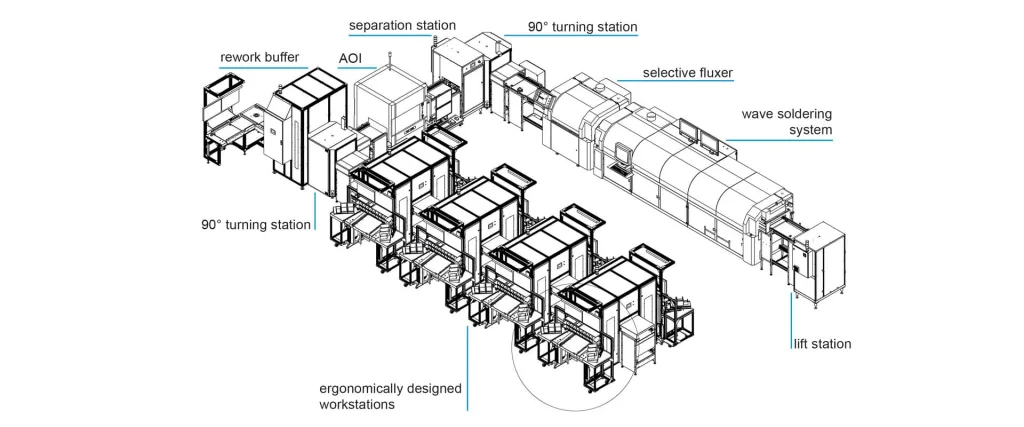
    The entire line concept, including a SEHO wave soldering system, is arranged in U-shape and designed for high production volumes. To use the space as efficiently as possible, the eight assembly workstations required were arranged in four opposite positions, each using a shared main transport segment to the manufacturing line.
    Ergonomic considerations were a key focus when planning the workstations, with individually height-adjustable tables, tiltable units for assembling components, material storage areas, and line side racks in which the assembly components are arranged clearly and within easy reach. From a logistical point of view, the integrated line side racks also offer the advantage that they can be set up anywhere, thus avoiding unnecessary interruptions.

    Once a PCB is fully assembled, the soldering frame is transferred from the workstation to the main transport system at the touch of a button by a handling unit, fully automatically and with automatic height adjustment. Each assembly passes through a THT AOI system, which enables complete inspection of assembly quality. Defective assemblies are identified via a separation station and automatically returned to the original workstation, while correctly assembled boards can proceed directly to the wave soldering system.
    After the soldering process, the soldered assemblies are lowered to the return conveyor level and pass through the AOI system again for solder joint inspection. Fault-free soldering frames are then transported to the respective workstations. A central rework buffer, in which faulty assemblies are buffered until further processing, prevents backlogs.

    The path of the soldering frames within the manufacturing line is automatically controlled via RFID. As an alternative, the line can be equipped with barcode readers or other identification systems.

    The degree of automation of such a production line can be flexibly expanded, for example, by using lightweight robots for assembly, which can be integrated centrally into the manufacturing line or decentrally at individual workstations.
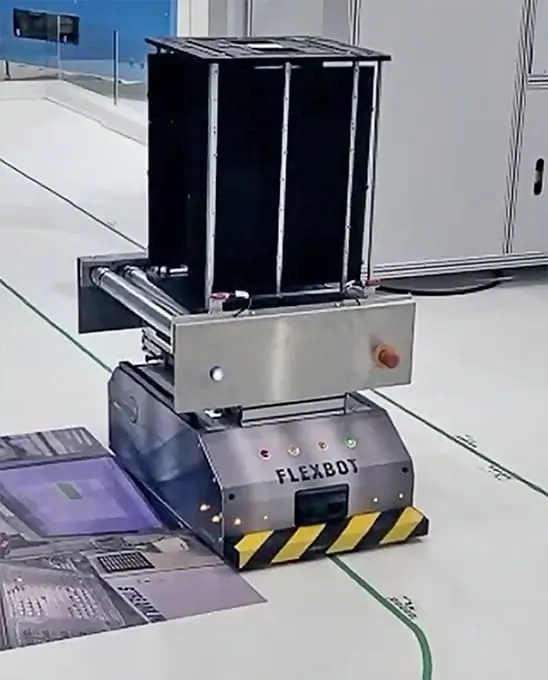
    Driverless transport systems (AGVs) also offer potential: they ensure a continuous flow of materials and take over the automated transport of assemblies to the next step in the manufacturing process.
    This approach can gradually increase overall production efficiency while relieving operating personnel of non-value-adding activities.

    Automated complete solutions

    Automated complete solutions that virtually eliminate the need for manual intervention can make the production of THT assemblies even faster and more precise.

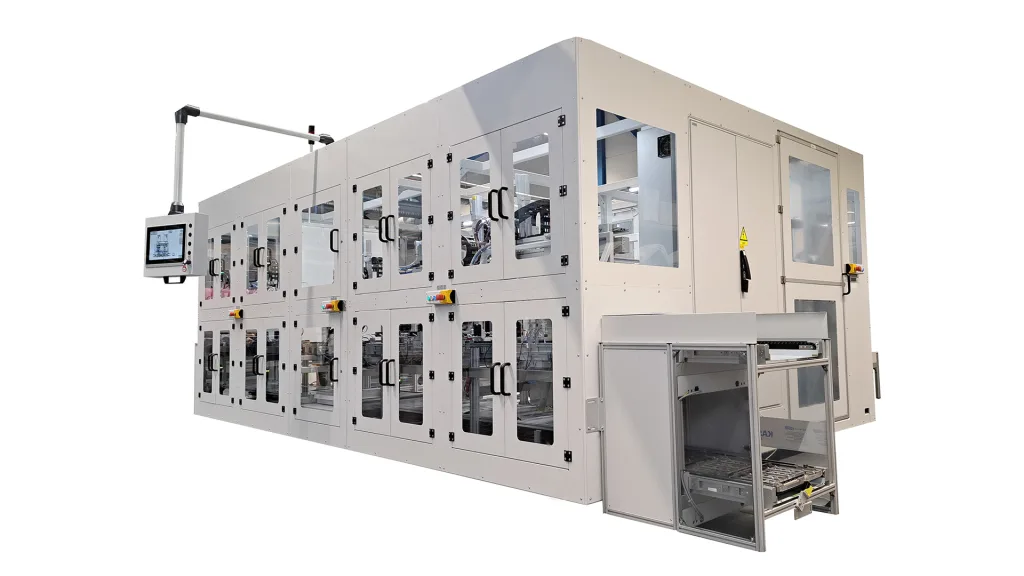
    In one such project, SEHO developed a fully automated production cell in which all process steps are automated.
    This includes assembly with subsequent automatic inspection, insertion of assemblies into workpiece carriers, automatic carrier closure, unloading of workpiece carriers after soldering, solder joint inspection and final automated pass/fail sorting – all without personnel involvement.
    The assemblies processed in this system are also controlled via a code reading system connected to a host computer.
    This results in a fully digitized process offering maximum transparency, consistent quality and minimal personnel requirements.

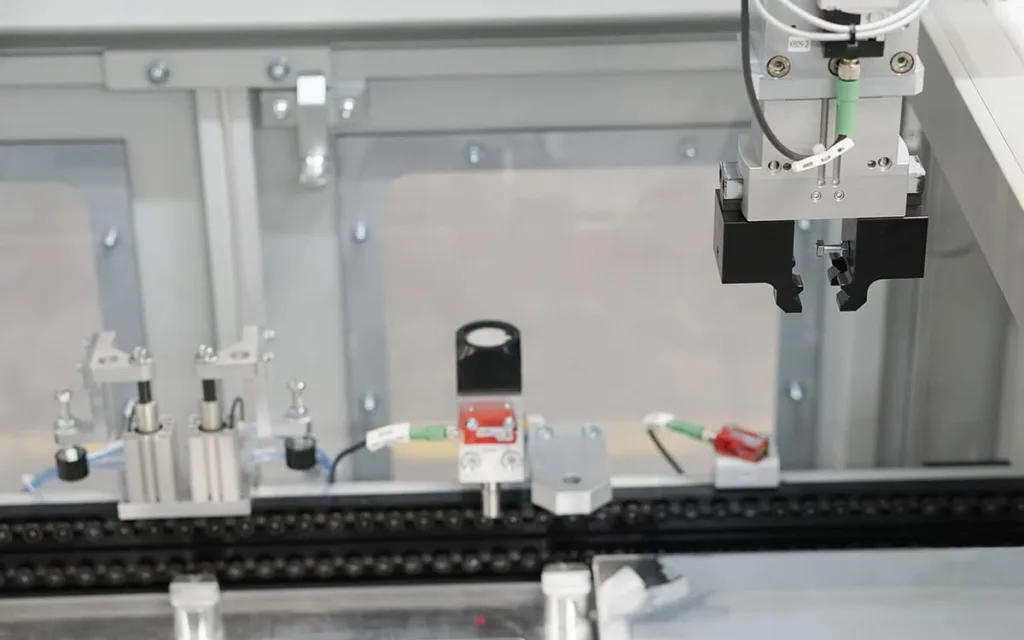
    high-precision gripper systems perform monotonous tasks in automated production cells
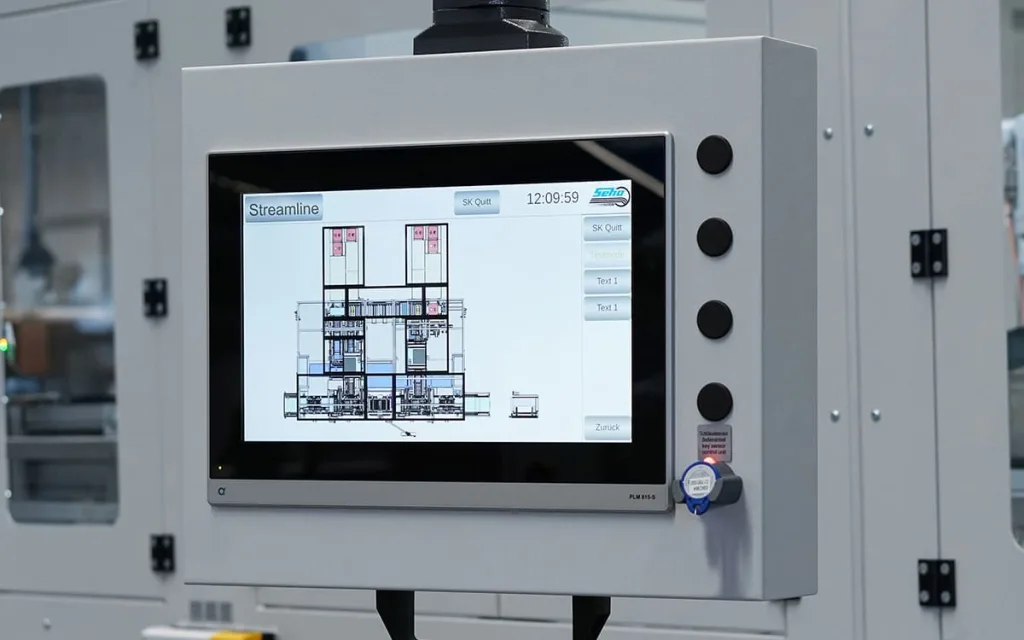
    automatic management of assemblies and fully digitized, traceable process

    Conclusion: THT automation ensures productivity and competitiveness

    The appropriate level of automation required depends on the specific application. Not every production line needs to be fully automated. It is more important that the chosen solution is suitable for the product, budget and planned development of the production site.
    Scalable automation opens up the possibility of moving toward the future with a step-by-step investment – starting with basic automation and progressing to a fully automated production line. It is worth considering future expandability from the outset of the planning phase. The more prepared the system is, the easier it will be to integrate future requirements, whether due to increased quantities, new product variants, or additional process steps.

    The benefits are obvious: automated processes ensure stable workflows and shorter throughput times, significantly increasing overall efficiency in production. Sources of error that can occur in manual processes are reduced, with positive effects on product quality and rework. They relieve staff of repetitive tasks and enable complete traceability.

    For electronics manufacturers who want to remain competitive in the long term, automation in the THT sector is therefore becoming a strategic factor.

    Want to learn more?
    Visit our Automation page.

    FAQ about Automation in THT Manufacturing

    Automation eliminates typical bottlenecks such as staff shortages, fluctuating cycle times, and high defect rates in manual processes. It ensures more stable processes, end-to-end traceability, and minimizes downtime, which can quickly become critical when order situations change.

    While SMT manufacturing lines have been highly automated for years, THT manufacturing involves many manual steps, such as handling of soldering frames, assembly, and quality control. This results in greater dependence on staff availability and manufacturing routines. Automation reduces precisely this variability.

    Even individual steps such as automated soldering frame handling, inline AOI, or ergonomically standardized assembly workstations significantly increase process stability. These investments quickly pay for themselves, especially with changing quantities or variant production, because they reduce scrap and make throughput predictable.

    Conditions are changing: product variants, batch sizes, vertical range of manufacture. A scalable concept enables the integration of robots, AGVs, or additional workstations at a later date without having to rebuild the basic structure of the line. This reduces future investment risks and makes it easier to balance the peak loads.

    THT products differ in terms of geometry, weight, thermal requirements, and handling. Standard systems quickly reach their limits here. A customized solution optimizes material flow, space requirements, transport concept, and user interfaces precisely for the respective product portfolio, thereby achieving higher OEE values.

    The production line, which covers just 120 square meters, combines a U-shaped layout, ergonomic assembly workstations, automatic soldering frame transfers, a THT AOI with component placement control and solder joint inspection, and a wave soldering system to form a continuous production concept. The automatic return of defective assemblies and the management of soldering frames via RFID ensure high process reliability and clear material flows.

    In fully automated THT production cells, all process steps – component placement control, workpiece carrier handling, soldering, AOI, sorting – run without manual intervention and are fully digitized. This results in reproducible quality, stable cycle times, reduced personnel requirements, and clear traceability throughout the entire process.

    Automated processes ensure improved cycle times, less rework, and high machine availability. At the same time, employees are relieved of non-value-adding activities, allowing them to focus on skilled tasks. This helps to maintain production even during periods of labor shortages and cost pressures.

    Thermographic monitoring of flux application sets new standards.

    We couldn’t be more proud: Our technology for process-integrated, inline-capable monitoring of flux application, developed in collaboration with SIEMENS AG, Foundational Technologies Berlin, was awarded second place in the Future Markets Cluster at productronica 2025. This award is impressive confirmation of how relevant and forward-looking this development step is for electronics manufacturing.

    A breakthrough for a process step that was previously impossible to monitor

    The application of flux in wave and selective soldering is a key process step, but one that has been difficult to control until now. Too little flux leads to soldering errors such as incomplete penetration or cold solder joints, while too much can cause residues that can impair the function of the assembly.
    Previous monitoring methods are generally based on random sampling or purely functional checks of the fluxer. They therefore do not provide any information about the actual application on the individual printed circuit board.

    This is precisely where the new technology comes in: For the first time, it is possible to test every printed circuit board inline and automatically. Not only is the amount of flux applied monitored, but also its exact position.
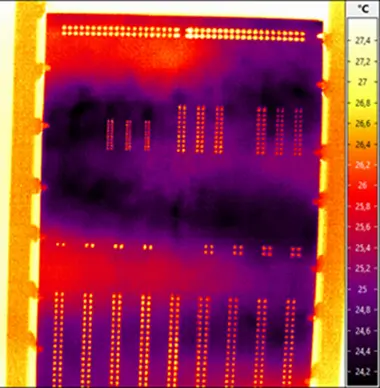
    The system utilizes the physical effect that heat is locally extracted from the assembly when the solvent in the flux evaporates. This makes wetted areas appear cooler.
    A thermal imaging camera captures this pattern immediately after fluxing and evaluates it intelligently. The analysis is based on a reference model, either a thermographic image or a CAD-based digital twin.

    non-uniform flux application

    The result is a reliable, highly accurate decision as to whether an assembly is correctly fluxed and approved for the soldering process.

    More quality, more efficiency – and the path to autonomous manufacturing

    The practical implications are enormous: Incorrect flux application is detected immediately rather than only becoming apparent after soldering, and the corresponding assemblies can be automatically removed from the production line.
    This reduces waste, prevents unnecessary rework, and increases process reliability throughout the entire production flow.
    At the same time, the technology forms the basis for future AI-supported optimization in real time. The thermographic data collected can be used in the future to automatically adjust process parameters and implement adaptive, self-regulating manufacturing.

    As a result, the system not only closes a long-standing gap in process monitoring, but also opens up new possibilities for quality, efficiency, and automation, especially in areas with high requirements.

    An award that stands for a strong team

    This award is a special achievement for us at SEHO, as it demonstrates what can be achieved when expertise in manufacturing technology, software development, and research come together.
    We would like to thank everyone involved for driving this project forward with passion and an innovative spirit, and of course we would like to thank the jury of the productronica Innovation Award for this outstanding recognition.

    We are excited and proud that SEHO has been nominated for the productronica Innovation Award 2025 with its latest development for process-integrated monitoring of flux application in wave and selective soldering processes!

    Automated control of flux application – a milestone in electronics manufacturing

    With the inline-capable, process-integrated control of flux application, fully automated and seamless monitoring of this critical process step in electronics manufacturing is now possible for the first time. Developed in collaboration with SIEMENS AG, Foundational Technologies Berlin, the solution sets new standards in soldering process monitoring.

    The new solution is based on thermographic detection of flux application and analysis of wetted areas in terms of their location and extent. Automatic decision logic evaluates the quality of the application and only releases assemblies for the soldering process if they meet the requirements.
    Additionally, the system paves the way for AI-driven process optimization in real time, marking a significant step towards the smart factory.

    Your advantages in wave and selective soldering

    A process step that was previously unmonitorable can now be controlled! Errors in flux application are detected before they lead to soldering defects, rework or scrap.

    The result:

    • significantly higher manufacturing quality
    • reduced process costs due to less rework and scrap
    • increased machine availability and efficiency
    • stable and reproducible soldering processes

    The prestigious productronica Innovation Award, presented in collaboration with the trade journal productronic, honors the most innovative new products and manufacturing processes in electronics manufacturing in six categories.
    Criteria such as technical innovation, cost-effectiveness, design, and system integration are evaluated. The winners will be announced at the main press conference of productronica 2025.

    Meet SEHO at productronica 2025 in Munich

    Experience the new solution for soldering process monitoring! For information on other new products from SEHO and your free productronica ticket, please visit our productronica web page.

    We look forward to seeing you in hall A4, booth 578.

    Greater Efficiency, Greater Process Reliability:
    SEHO Sets New Standards in Selective and Wave Soldering!

    From November 18 to 21, 2025 the international electronics manufacturing community will gather in Munich for productronica, and of course we will be right in the thick of things – with innovative technologies and upgrades for high-end systems from all product areas!

    Experience the world of soldering technology up close with us: Optimized for demanding applications in electromobility and power electronics, impressive with sophisticated process architecture, high flexibility, and consistent focus on efficiency.
    Get inspired and see what is already possible today to make your production sustainable and future-ready!

    Meet SEHO in hall A4, stand 578!

    Our Highlights at productronica 2025

    Selective Soldering

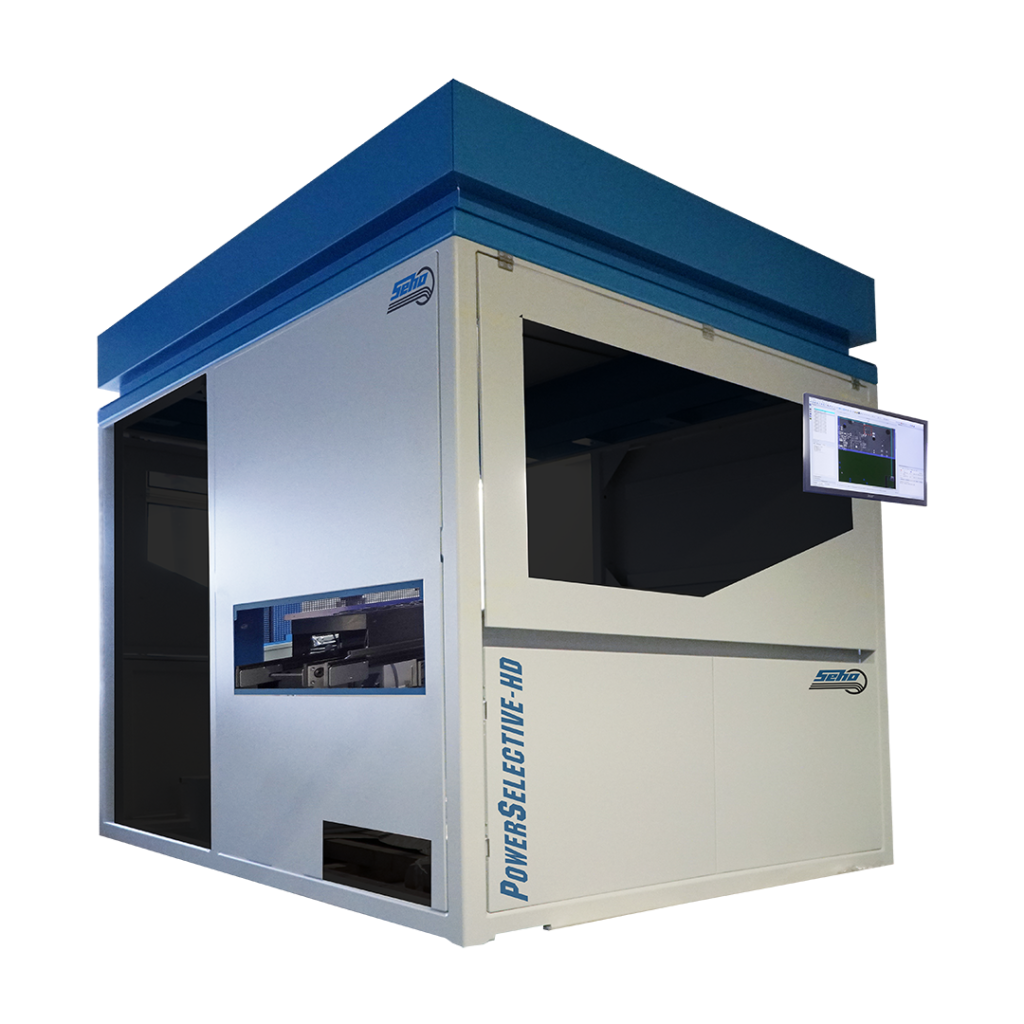
    The new PowerSelective-HD offers the perfect combination of flexibility, energy-efficiency and process reliability.
    A new, innovative cluster preheating concept specifically heats only the relevant assembly areas, significantly reducing energy consumption. The new, flexible soldering unit accommodates several multi-nozzle tools simultaneously, thereby significantly increasing throughput. An eco mode ensures resource-saving operation, while additional integrated processes such as the selective brushing system and THT-AOI system offer maximum process reliability.

    Wave Soldering

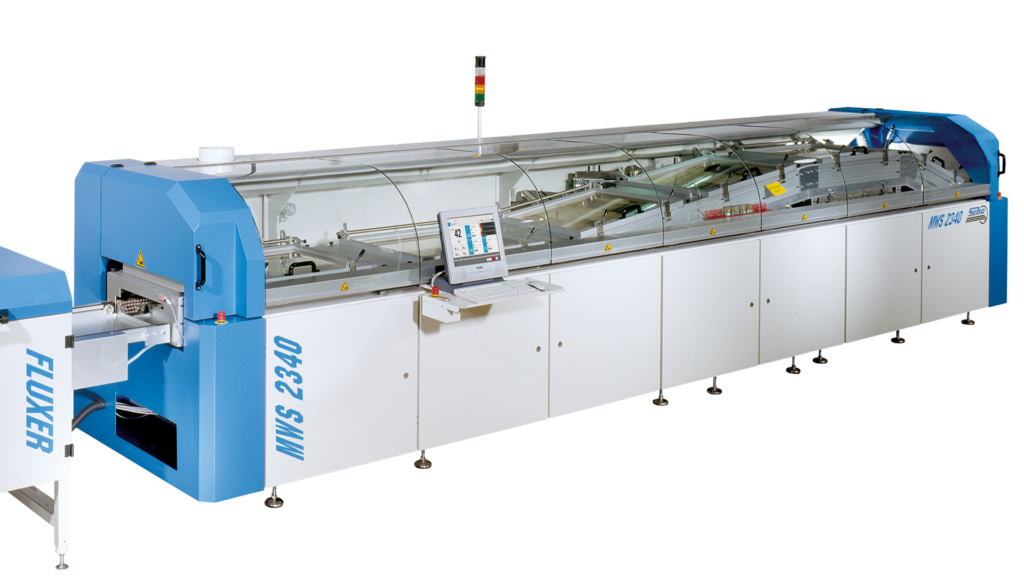
    Increased efficiency and intelligent process control are also the focus in wave soldering. The segmented flux application enables potential savings of up to 50 % depending on the assembly layout: Only those areas of the assembly where solder joints are actually located are applied with flux. This reduces consumption and maintenance requirements, and also has a positive effect on the process. In addition to the energy savings achieved in the preheating area with innovative pulsar emitters, the newly developed tunnel insulation also significantly reduces resource consumption.

    THT Inspection

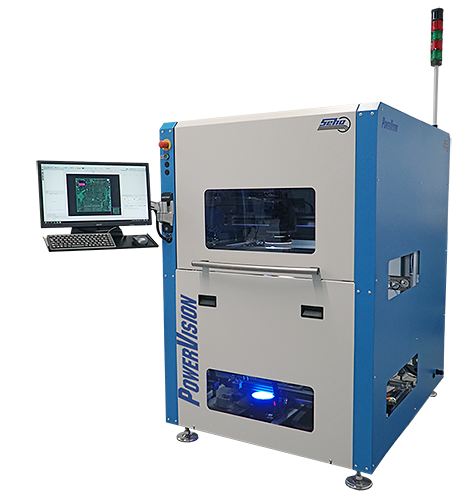
    AOI made easy: The SEHO AssemblyCheck component placement inspection system and the SEHO PowerVision THT-AOI system guarantee the high quality of your products right from the start!
    Optimized for the THT process, individually configurable for your manufacturing requirements, and flexibly integrable into the production process.
    AOI systems from SEHO focus on two key areas: Continuous quality assurance and cost-efficient manufacturing processes.

    SEHO Systems India will exhibit at productronica India 2025, taking place from September 17 – 19, at the Exhibition Centre (BIEC), Bangalore International.

    Visit us at booth H4.D51 and meet the SEHO experts to discover our latest innovations in soldering technologies and automation solutions.

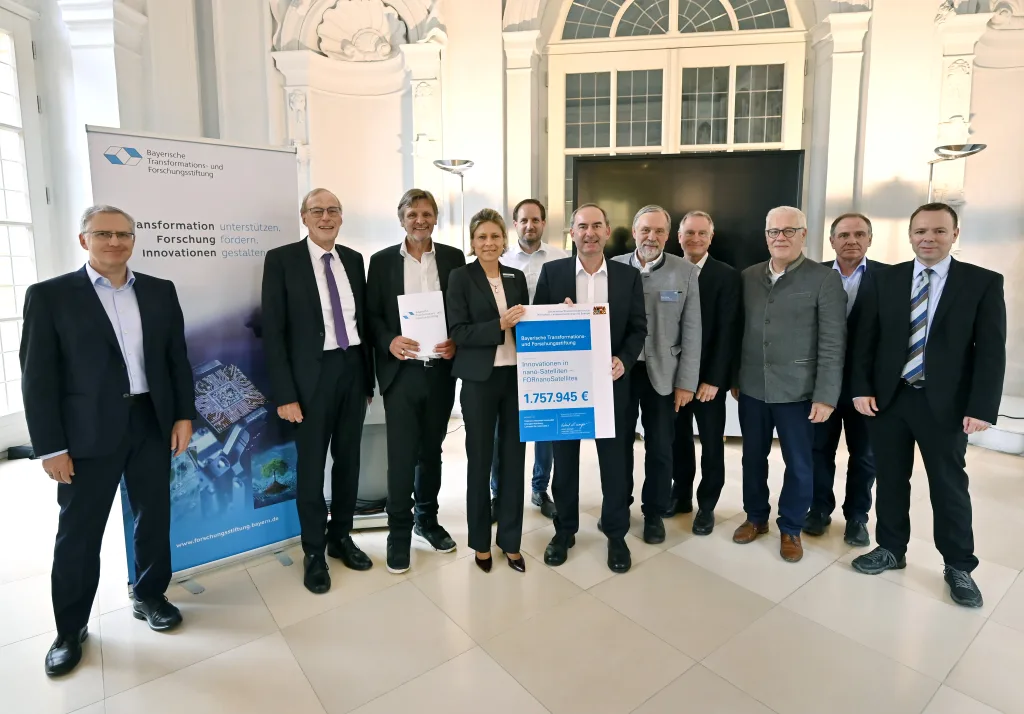
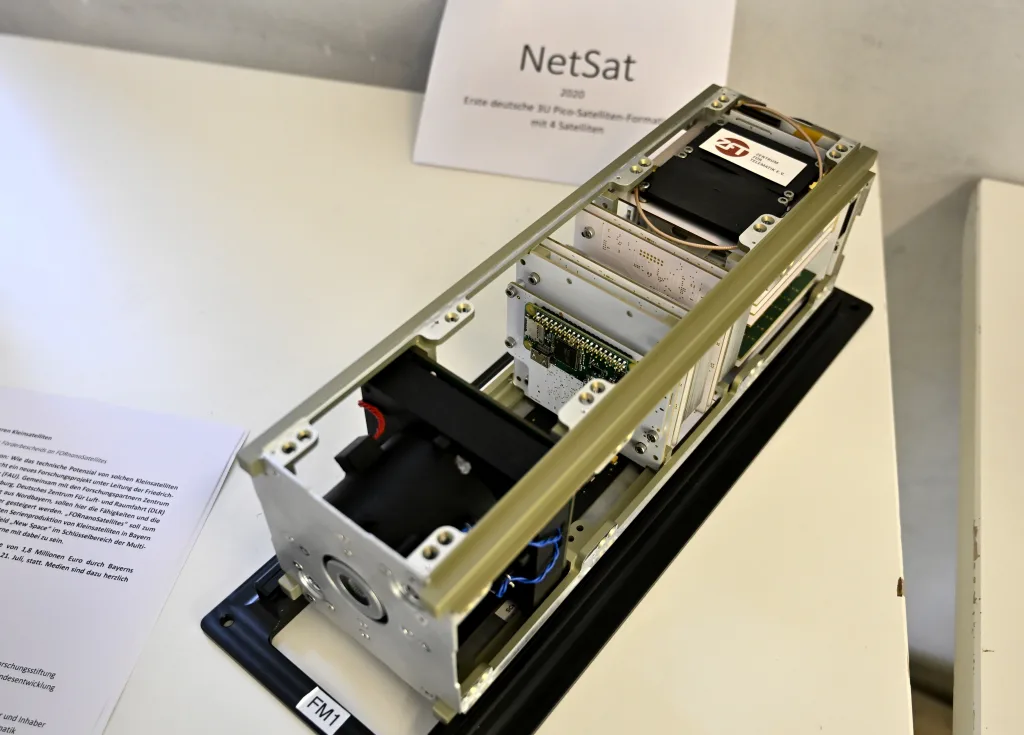
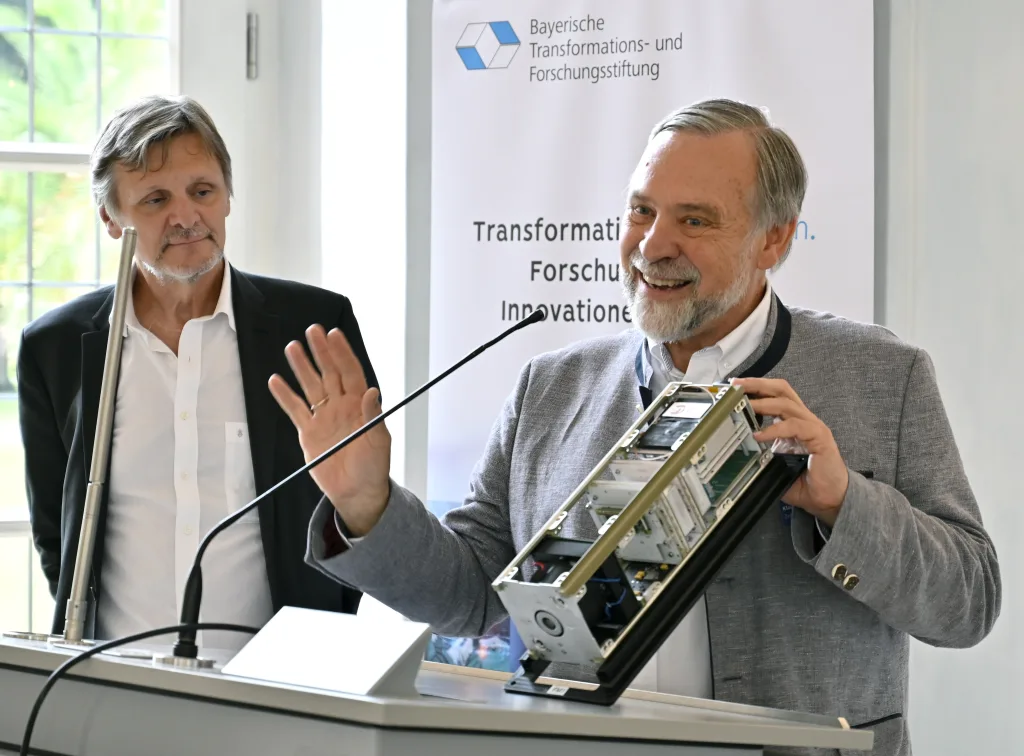
    We are a partner in the FORnanoSatellites research project, coordinated by Friedrich-Alexander University Erlangen-Nürnberg (FAU) and funded by the Bavarian Research Foundation with approximately 1.8 million euros. The aim of the project is to develop innovative technological components for small satellites and to establish an automated small-batch production in Bavaria.


    Our role in the project focuses on interconnection technology: we support the research partners in developing system-in-package solutions using additive metallization to efficiently integrate electronic and mechanical components in highly compact spaces. This enables us to contribute significantly to improving the compactness and performance of small satellites. The close collaboration with universities, research institutions such as the German Aerospace Center (DLR), and other industry partners offers us the opportunity to further develop our technology in a practical context and tailor it to new applications.


    FORnanoSatellites not only strengthens technological independence in the aerospace sector but also boosts the innovative capacity of small and medium-sized enterprises in Bavaria – we are proud to be part of this forward-looking initiative.

    Photo credit: (FAU/Harald Sippel)

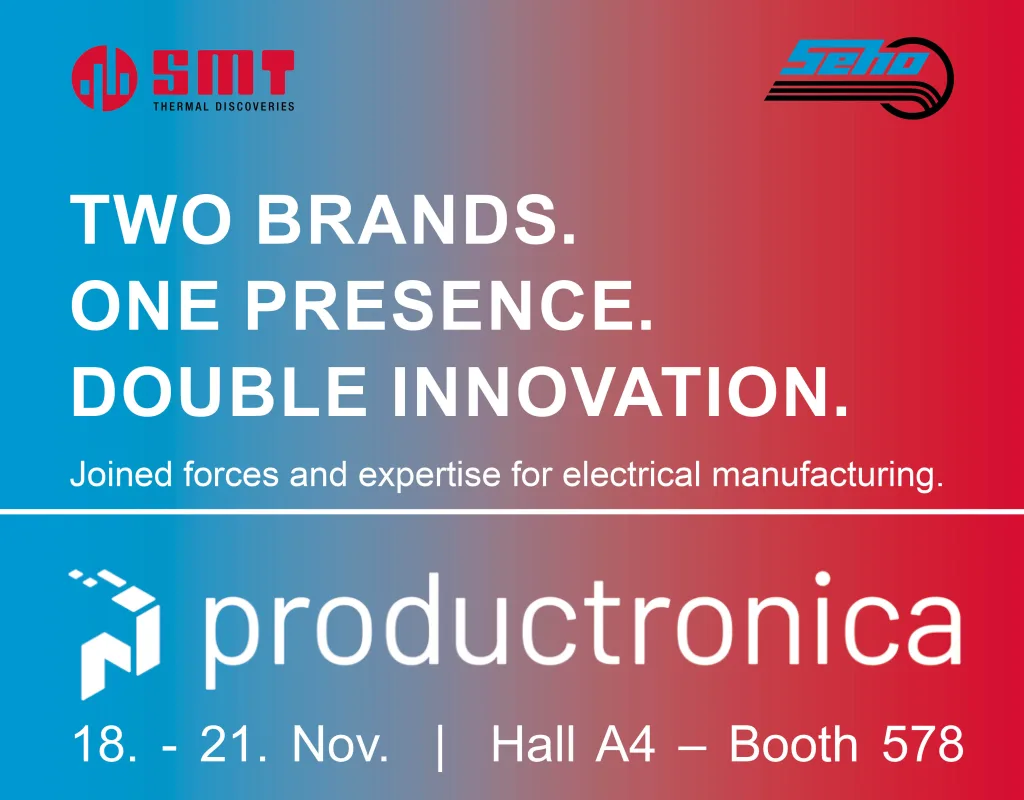
    SEHO Systems and SMT Thermal Discoveries will exhibit jointly at Productronica 2025 in Munich. The two specialists in electronics manufacturing will combine their expertise and strengths and welcome visitors from November 18th to 21st, 2025, in Hall A4 at Booth 578.

    Selective soldering, wave soldering, reflow soldering, reflow soldering with vacuum, automatic optical inspection, automation technology, temperature treatment, soldering systems for power electronics using formic acid: Experts welcome you on over 200 m² of exhibition space to provide information and advice on the latest technologies in these areas.

    In addition to established reliability – with low maintenance requirements – energy efficiency and individual adaptation to specific customer needs are the special focus of the latest product generations.

    Plan your visit now, we look forward to seeing you!


    SEHO Systems & SMT Thermal Discoveries


    Convinced? Then apply now!

    Do you need more information? Then feel free to contact our HR department.

    Larissa is the heart and soul of our HR department. You will meet her, for example, when we welcome you for a job interview.

    Larissa Hepp

    Human Resources

    You want to make a career with us?

    Let's talk!

    Follow us on our social media channels

    We participate in the
    Environment and Climate Pact of Bavaria

    umwelt-kilmapakt-by-white

    2026 © SEHO Systems GmbH – all rights reserved

    • Company
    • Products
    • SEHO 360°
    • CareersVacancies!
    • Distribution network
    • Contact & Service